Saturday, January 11, 2014

Antares, International Rocket for an International Station


One of the two rockets being put to use these days in resupplying the International Space Station is the Orbital Sciences Antares, named for a star in the constellation Scorpius. Antares is a two-stage rocket intended to carry the Cygnus resupply vehicle (a more detailed post can be written about that if there's interest).

Antares is a multinational project, assembled from components built in 4 different countries on 3 continents, which is incredibly appropriate for a vehicle intended to resupply an international scientific outpost. So let's check out the parts from the bottom up:


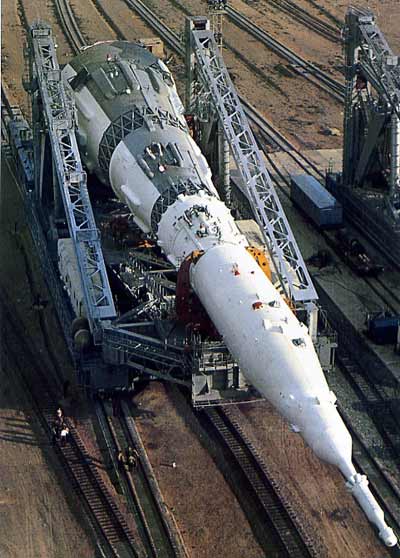
 AJ-26 Rocket Engines - The part that really makes the thing get up and go! Antares has two of them and when they were originally built they were called NK-33's. These engines have a pretty interesting history because they were built in the late 1960s. 
By the Kuznetsov Design Bureau. 
In the Soviet Union
For the N1...their MOON ROCKET!

That rocket was unsuccessful overall but these engines were so advanced at the time that they're still up to modern performance standards with some relatively minor upgrades from the Aerojet Rocketdyne company in California, who has a large enough stock of those motors to supply the Antares for all eight contracted flights to the ISS with some to spare. Antares has two engines that are gimballed, meaning they're mounted in a way that they can be tilted to steer the rocket.

First Stage Fuel Tanks & Structure - The bulk of the rocket is made up of this first stage structure that contains a fuel tank for liquid oxygen (takes up about 2/3 of the length) and a fuel tank for RP-1, a modified form of kerosene. There are also helium tanks built into the fuel tanks that are used to force the oxygen and kerosene out of their tanks and into the engine as quickly as possible. This major section is designed and built by Yuzhnoye Design Bureau in the Ukraine, based in large part on the Russian Zenit rocket.

Interstage Assembly - This is the section that connects the first stage to the second and helps keep the rocket on the right course as it gets close to orbit by operating thrusters, small rockets used to control direction, as the rocket cruises between stages. Built largely from US-based Orbital Sciences' flight computers used on the Pegasus air-launched rocket, this hardware is considered exceptionally reliable which is great because if the rocket can't stay on course then there's no point in launching at all.

CASTOR® 30B Second Stage Motor - Unlike the first stage motors, the second stage is a solid-fueled motor built by Alliant Techsystems (ATK), a manufacturer from Utah that also built the Solid Rocket Boosters for the Space Shuttle. At a recent tour of NASA's Wallops Flight Facility a representative of ATK stated that the fuel formula they're using for Antares is a drastically better than the shuttle fuel which was designed in the 1970s.

Cygnus - The only part of the entire launch that will make it to orbit is this capsule-type spacecraft. It's made of two sections, the Pressurized Cargo Module (PCM) and the Service Module (SM). The SM is the "brains" of the vehicle, containing the solar panels, the rocket engine and thrusters, communications systems, and the environmental controls for inside the PCM, which is where the supplies and hardware meant for the station are stowed away. The SM is based largely on satellite hardware developed and built by Orbital Sciences in the United States. The PCM, on the other hand, was developed and built by Thales Alenia of Turin, Italy, sharing its design heritage with many sections of the space station and the Automated Transfer Vehicle (ATV) built by the European Space Agency.

 All those pieces from all those countries come together at the Horizontal Integration Facility at NASA's Wallops Flight Facility where they become the Antares rocket, one of America's newest launch options that is making low-Earth-orbit resupply an economic and routine process.

I hope you enjoyed this explanation of the Antares rocket and if you have any questions, comments, or suggestions then go ahead and leave a comment below! As always, thanks for reading!

Monday, January 6, 2014

Second Space Age - Orbital Sciences Corporation

If you live on the east coast of the United States then it's likely that over the past year you've been introduced to the work of one of the major players in the Second Space Age, Orbital Sciences Corporation. (If you don't live in that area or have never heard of them, please read on anyway!) They've built and operated the various rockets that have been flying out of NASA's Wallops Flight Facility on the eastern shore of Virginia. Their launches have caught the attention of the public lately thanks to their frequent night-time launch windows (the short time that physics dictates as just the right time to launch a particular mission).

Orbital Sciences is one of two companies contracted by NASA to deliver supplies and new science experiments to the International Space Station under the Commercial Orbital Transportation Services (COTS) program. (We'll discuss the other company in the near future.) Based in Dulles, VA, Orbital Sciences was founded in 1982 and has developed an impressive reputation in the small- and medium-class satellite business, having produced about 140 satellites with two primary focuses. The first is communications and the second is remote sensing which means using instruments aboard the satellite to make measurements and observations of Earth which can be used in scientific studies, military operations, and commercial uses like urban planning and farming.

They've also been building and flying rockets very successfully, and interesting ones at that! Their Pegasus rocket has a triangular wing and is launched horizontally after being dropped by a Lockheed L-1011 carrier plane at 40,000 feet. This has the great advantage of getting the rocket above the thickest part of the atmosphere so the rocket experiences less resistance and it's above most of the weather so the odds of being able to launch are increased greatly.

The rockets that have been catching the public's attention, however, are the Minotaurs (like the one used to launch LADEE a few months ago) that Orbital Sciences have created by acquiring decommissioned US Air Force Minuteman and Peacekeeper missiles and using them as the first two stages then mounting their own flight-proven rockets and computers on top with their satellite payloads. This gets to the heart of what Orbital Sciences does often and does well: assembling pieces that have excellent success rates and are readily available. In this way they are able to put together launch vehicles that are safe, reliable, capable, and cost-effective. That is a crucial ability for any company hoping to hold a position as major player in the satellite launch world and especially when helping pioneer commercial cargo service to our space station.

The next entry will be about Orbital Sciences' newest rocket, the Antares, which will be launching this Wednesday, January 8th, and later in the week I'll introduce you to do Cygnus cargo vehicle that is serving as one of two  commercial resupply vessels for the International Space Station.

If you have any questions about Orbital Sciences or anything referenced here please leave a comment!

Wednesday, January 1, 2014

The Second Space Age: An Overview

Whether the general public knows it or not, we're in the middle of something amazing. We're living through a "Second Space Age." These past couple years, new rockets and new spacecraft have been coming online and entering service as spaceflight in the United States shifts from government-based to commercially-operated. During the Space Shuttle era, NASA owned and operated their fleet of vehicles and over the shuttle's 30-year history that ownership and operation proved to be more costly than anticipated. While it allowed us to build the International Space Station, the next necessary step to permanent human habitation off this planet, the complex and maintenance-heavy shuttle fleet also drained funding away from new vehicle development. So many people were screaming out to the whole of the internet when the shuttle fleet was retired, fearing that NASA was closing up shop, giving up on sending people into space...but the reality is the exact opposite. NASA had cleared up an immense portion of their ever-declining budget to move on to the next target: exploration beyond Earth orbit.

NASA's new capsule, the Orion, has been making steady progress towards providing us with a vehicle that can take us to asteroids, the moon, and beyond. Most people seem to think it's still just an idea, a concept on a drawing board, but in September of this year the Orion is scheduled to make its first unmanned trip into space. Several years from now it will ride skyward with a crew atop one of the newest and largest rockets in the world: the Space Launch System (SLS).
This rocket makes use of flight-proven hardware such as solid rocket boosters and Space Shuttle main engines (which were so reliable that they were reusable) while also adding in 21st century technology such as composite structure fuel tanks that will be lighter and stronger than the old aluminum alloy tanks. Less weight there means more weight that can go into space. More bang for the buck, figuratively and literally.

But what about the Station? It's still there and still needs to be resupplied and crews exchanged every few months, right? Of course, and this is where the Second Space Age really comes into being. In the short term we've been able to ride with our partners from Russia, who took up the task of manned flight with their Soyuz spacecraft, a vehicle with an impressive safety record over its nearly 50 years of operation. (Don't worry, it's had many upgrades and modifications since the old days!) That's the beauty of an International Space Station, you can work with others to assure continued service.

A lot of people in this country, however, disapprove of sending astronauts (and dollars) to another country to get to space. The long-term side of the plan has been for NASA to work with private corporations to develop several different spacecraft and rockets that will be able to deliver crew and cargo to the ISS, in a way handing over the "routine" aspect of space to private companies that can compete to do it efficiently and at competitive costs. NASA has shared its vast technical knowledge with US-based aerospace corporations and some of those companies are already providing results. 
SpaceX's Dragon and Orbital Sciences' Cygnus have already made trips to the ISS under cargo resupply contracts and may just be a few years until we see private companies operating crewed spacecraft. And the day that a commercially operated, manned vehicle makes it to space will be a VERY big day.

So to summarize the future: private companies operate the rockets that put people into earth orbit and send cargo to the ISS, leaving NASA a bigger chunk of budget to do the bolder, more ambitious projects that take us away from Earth.


There's an impressive collection of companies and individual that are doing amazing things now and in the near-future. Through this "Second Space Age" series you'll be introduced to the new rockets, the new spacecraft, the companies that are building/operating them, and the amazing way it all fits together to expand humanity's ability to understand and navigate through our universe.

Any questions or feedback will be much appreciated. I want to write what you want to read about so let your opinions be known!

Friday, November 22, 2013

One Day, Two Launches

This upcoming Monday, November 25th, will be a busy day in the launch world with the flight of two very different missions.

The next resupply spacecraft to the International Space Station (ISS) is the Progress 53 mission flying out of the Baikonur Cosmodrome in Kazakhstan, scheduled for lift-off at 3:53 pm Eastern and will typically dock with the station on Friday the 29th. The Progress vehicle is an unmanned version of the Russian Soyuz capsule that has been in use since the 1960s. These designs have had such a long lifespan because they are relatively simple (as simple as spaceships can be), very durable, and adaptable. Progress is able to carry a little over 3,700 lb of supplies in the somewhat spherical forward section called the Cargo Module. Typical supplies include food, water, replacement parts and new scientific experiments to be installed on station. The center segment of the vehicle is the Refueling Module and this will carry up to 3,800 lb of fuel that the ISS will need to maintain its orbit. Despite being at 250 miles above the Earth, there is still a slight presence of atmosphere creating drag on the station that, over time, slows it down and degrades its orbit. Progress will likely remain docked with ISS for up to 6 months, at which time the Cargo Module will be packed with the station's trash, waste water, and old station parts. After undocking it's sent back to Earth on a course that will lead to its incineration in the atmosphere above the Pacific ocean.

The other flight that day will be the commercial launch of the SES-8 communications satellite out of Cape Canaveral Air Force Station in Florida. This satellite, which was built by Orbital Sciences Corporation, will serve as direct communications satellite for southern Asia and has a designed service life of 15 years, according to the manufacturer's website. Interestingly, SES-8 will be put into orbit by a Falcon 9 v1.1 rocket built by one of Orbital Sciences' competitors: Space Exploration Technologies, more commonly called SpaceX. The Falcon 9 is a two-staged rocket designed and built in the United States, also used for commercial resupply of the ISS and is steadily evolving into what may be the first fully reusable rocket in the world.

Friday, November 15, 2013

The Basics of MAVEN

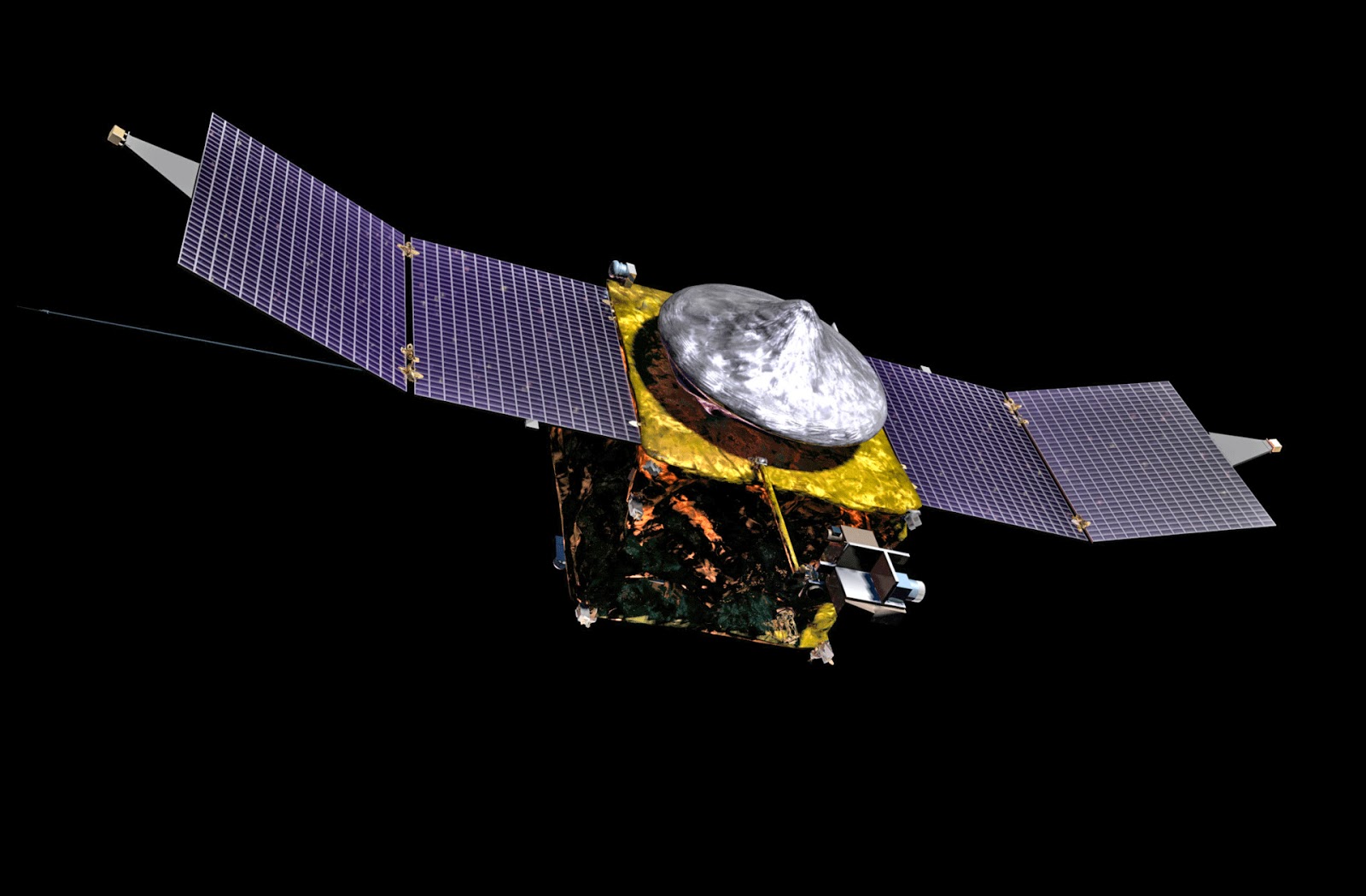
The United States' next mission to Mars will be departing Earth this upcoming Monday, November 18th from Cape Canaveral Air Force Station in Florida. MAVEN, the Mars Atmosphere and Volatile EvolutioN mission, will take 10 months to reach Mars then enter orbit. Once there, it will spend one Earth year (0.53 Martian years) passing repeatedly through the red planet's atmosphere where it will use its scientific payload to analyze the composition and physics of the thin atmosphere. To give a general comparison, Mars' atmosphere has only about 1/1000 the mass of our own.

Ground-based rover and lander missions have studied geological records of the planet's past and through that data it's become apparent that long ago Mars had a far more robust and complex atmosphere, possibly one like the Earth currently enjoys. The prevailing theory is that solar wind and radiation has had an eroding effect and scientists want to measure the rate of gaseous loss and ultimately understand if this is something that may someday cause changes to our own world. The other major benefit of MAVEN's research will be an understanding of what kind of atmosphere we would encounter on the first manned mission, allowing for more effective design and construction that will increase the chances of a successful landing on the red planet.

For more detailed information about this mission, check out the official Fact Sheet.

Thursday, November 14, 2013

A Return to American Independence

We have reached the end a two-year gap in America's ability to resupply the International Space Station (ISS) from our own soil. With the retirement of the Space Shuttle fleet in 2011 we lost our ability to regularly loft supplies and new experiments to the space station, leaving us no options but to pay out hundreds of millions of dollars to companies and agencies across the planet to do our work for us. But that is now a thing of the past.

Yesterday NASA held a press conference to officially and successfully conclude the Commercial Orbital Transportation Services (COTS) program that created a partnership between NASA and private aerospace corporations to develop rockets and spacecraft that would meet NASA's technical, performance, and safety standards. NASA set the guidelines and the private companies entered into competition to build what they thought would be the best vehicle at the best price.


Several companies made efforts to enter this new space race and in the end Space Exploration Technologies (SpaceX) and Orbital Sciences Corporation were selected to fly demonstration flights. The selection of multiple companies will ensure that the market for NASA resupply missions will remain competitive, controlling costs and incentivizing increased performance. Both companies have had great successes with their rockets, the SpaceX Falcon 9 and the Orbital Sciences Antares and both vehicles, the SpaceX Dragon (above) and the Orbital Sciences Cygnus (right) have now successfully hauled cargo safely and efficiently to the ISS and Dragon is even able to bring cargo back for further scientific investigation after time in orbit.
 
The successful conclusion of this project is exciting, in part, because it certainly bodes well for NASA's other major vehicle initiative,  the Commercial Crew Program (CCP). A parallel to COTS, CCP is an effort to develop, with industry cooperation, safe and reliable manned spaceflight vehicles to transport crews routinely to and from the ISS. Initial test flights for some of those commercial systems are scheduled for 2017 and upon their successful completion NASA would no longer have to sink a major portion of its budget into low-Earth orbit flights and can focus its time, efforts, and funding on sending manned missions to the moon, asteroids, and beyond.